Anvil
A browser IDE that keeps an AI agent, code, a real terminal, live preview, and reversible Git checkpoints in one workspace.
React · TypeScript · xterm.js · WebSockets · Git
Context
Agentic coding spans a conversation, a filesystem, running processes, and the application those processes produce. The client needed those parts in one browser workspace, where a developer could ask for a change, watch it reach the files, follow the command output, and inspect the result without losing track of what the agent had changed.
The harder frontend problem was keeping the panels in sync. Agent output, tool calls, file events, terminal output, and preview state arrived continuously. A screen that was only slightly behind could make the user trust code that was no longer current.
My role
I led the technical direction on a three-person team, with the product interface and frontend architecture as my primary area of ownership. My frontend work focused on the three-panel workspace; I also contributed across the backend and infrastructure, set the stack and quality bar, and reviewed the other developers' pull requests.
Scope
The team delivered:
- an agent conversation that planned and applied file changes;
- a navigable file tree and syntax-highlighted editor;
- a browser terminal backed by a real PTY;
- streamed agent, file, and process events;
- a Code/Preview workflow with hot reload;
- Git checkpoints for agent steps;
- controls for running and deploying the project.
The sandbox orchestration and persistence model were part of the team's delivery. I shared that work with the other developers.
Evidence
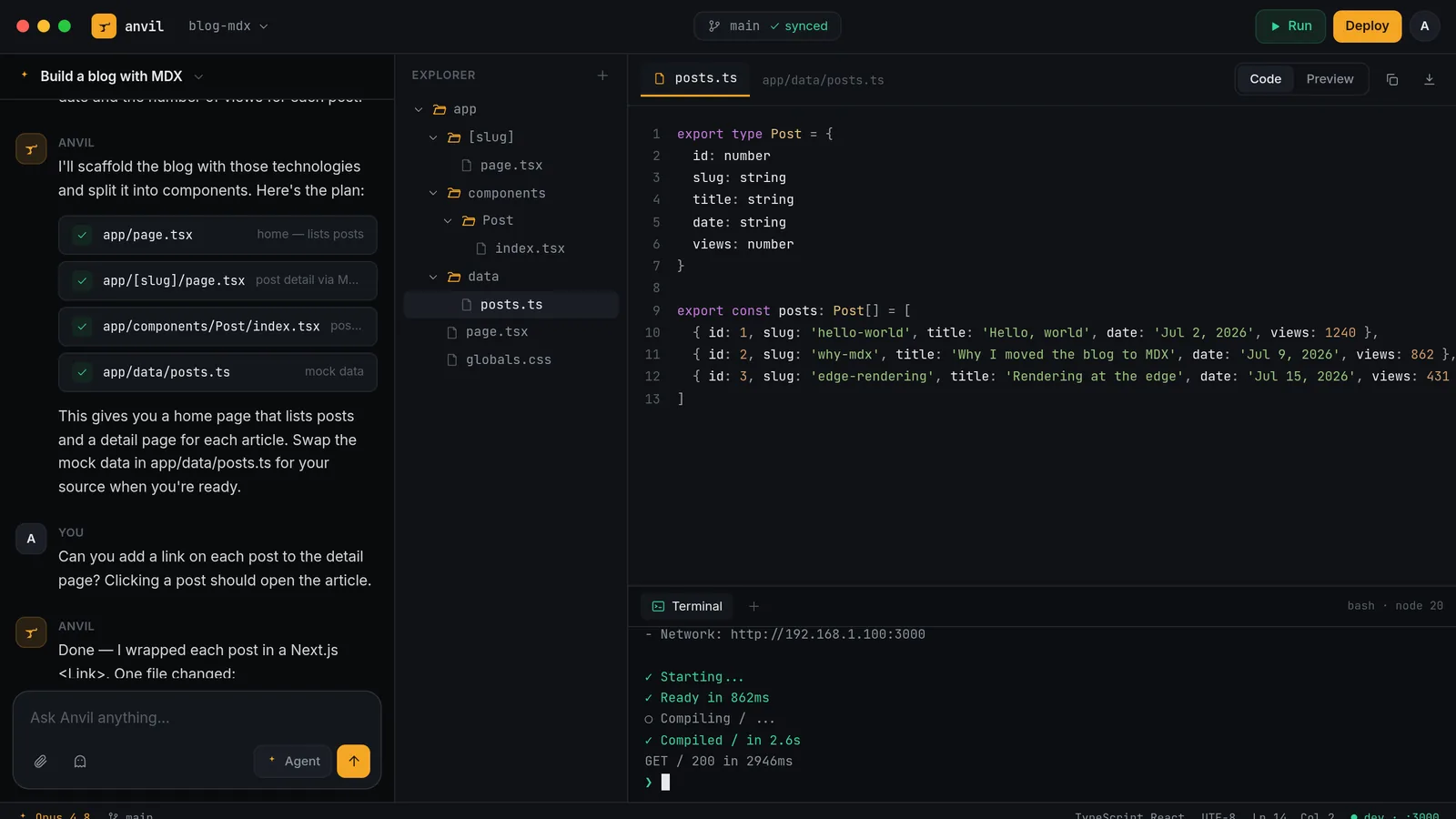
The reconstructed workspace above is the visual I can publish. It shows the agent plan and changed files beside a TypeScript editor, live development-server output, branch state, and Run and Deploy controls.
It documents the interaction model and the frontend surface I worked on. It is not a screenshot of the client's original interface.
Decisions
Keep the development loop in one frame
Conversation, files, code, process output, and preview belonged in the same workspace because each explains the state of the others. Moving them into separate pages would make the user reconstruct that state mentally.
Treat live output as product state
The interface had to keep file events, terminal output, and agent progress in sync so that a stale panel would not contradict another.
Make reversibility visible
Each agent step became a Git checkpoint that the developer could inspect or return to from the interface.
Outcome
The team delivered a browser workspace that joined agent interaction, code editing, terminal execution, live preview, and version history into one workflow. Developers could inspect the agent's changes and return to an earlier checkpoint.
Disclosure
This was client work completed by a three-person team. The client asked not to be named. "Anvil," its identity, sample project, data, and interface were created or altered for this portfolio reconstruction.
The capabilities and my role describe the delivered engagement; the published visual does not reproduce the client's original product. No client repository or production metric is public.